DOIN' THE SHATABDI SHUFFLE
We traveled far and wide on the subcontinent -- can't say how many kilometers we churned through, but we landed in 25 different cities and passed through countless other villages and towns in India and Nepal. We walked a lot, and putted around town in rickshaws and an occasional taxi. But while trekking from metropolis to hamlet, state to state, country to country, days and sleepless nights were spent on buses and trains, and even more hours spent on tracking them down and waiting for them.
Booking Passage
In the Trains at a Glance schedule book it states: "Indian Railways is the second largest railway system in the world, operates nearly 7,800 passenger services a day, and moves about 11 million people..." And they ain't just'a whistlin' Dixie. It's a massive system. The trains were by far the most comfortable and pleasant way to travel, but obtaining a ticket for one was oftentimes an exercise in frustration. The process began by scouring our schedule book for potential trains going to our destination, then heading on down to the local station. Invariably we would arrive to find the reservation counter closed or the computers down. In the meantime we would forage around for the forms to fill out to make reservations and ask questions at the Inquiry Counter. They, in turn, kindly referred us to the reservation counter set aside specifically for foreigners. A nice gesture, but unfortunately this window was also set aside for "military personnel, freedom fighters, and VIP's" (oftentimes a questionable distinction). It goes without saying, then, that we stood in line for quite some time. This is hard enough in the U.S., where people generally line up one behind another, patiently waiting. Not so, in these parts: why would you wait in line if you can walk straight up to the front of the line and push, poke or pull yourself in position to be the next person waited on? It was a hard lesson to learn, but we did our best -- it took all three of us to physically hold our position in line, and to get past our American "politeness" to defend ourselves against wily intruders. During this waiting time we also had the opportunity to read the plethora of signs painted on the ticket windows. My favorite was the list of people who could apply for discounts: the aforementioned military and freedom fighters, as well as students, medical assistance personnel, people with non-contagious leprosy, and musicians and artists, among others. We were lucky: most of the time we were able to get tickets of some sort; sometimes we were not. And when this happened, we turned, with very pouty faces and slumped shoulders, and trudged to that bastion of terror: the bus station.
They were never out of tickets at the bus station. Ever. Didn't matter if the bus was already full (which they always were), or if the bus was in sound working condition (which they always were not). All you had to do was step over the bodies stretched out on the cement in sleepy repose and offer up your money (not very much). A receipt would be handed back and a finger would point to some crumpled tin beast in the parking lot. "What time does it leave?" we would ask in earnest, but the answer was never right. Ever. And in the many hours of waiting at the station, we learned that bus station food, though a potential health hazard, was never fatal.
Tickets in hand, packs on our backs and excited to get to our next destination, we were ready. On to the station!
Train Daze (and Nights)
Train stations in India are alive; they throb with the goings-on of the Indian people, and with holy cows and wild boars, beggars and food vendors, and an occasional manifestation of Hanuman, the Hindu Monkey God. Hours were spent at stations in big cities and small villages, sometimes in frustration and contempt, but mostly in sheer wonder.
Travelers appear and disappear from view in a wink, shuffling to platforms ushering them to their seats. Some passengers carry reserved tickets in the comfortable first- and second-class, air-conditioned sleeper cars, but a great number of people are packed into "passenger" cars -- those frowzy trains with wooden benches, glassless and iron-barred windows filled with brown faces, and men -- sometimes four or six or eight, even -- standing in the doorways, clinging to the metal handles and steps.
Being warned in advance through our Lonely Planet guidebook ("What you want is a mail or express train. What you do not want is a passenger train."), and then filled with dread upon actually seeing one, we felt lucky the one time we were forced to take a "passenger" train.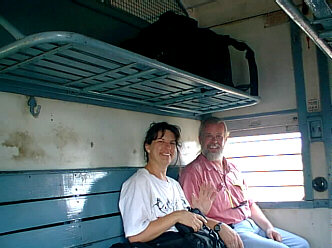 Out venturing in the "sticks" one day looking at Hindu temples, we found ourselves in Hassan, a small town close to, but not actually on, a major rail line. The only ride out of town was a "passenger" train costing 12 rupees, or about 28 cents. We were nearly alone on the train and enjoyed chugging slowly down the track, stopping in villages every few miles. The trip lasted about an hour, just about the time my butt started to feel sore because of the bench seats. The railway stations along the way were picturesque -- one or two small buildings surrounded by farm land and palm trees, wooden signs with the station name written in black script, and a man or two operating the red and green lights and keeping records. Many stations had Ghandi quotes painted on the walls and gunnysacks filled with grain or other goods stacked on the platform waiting to be moved. Cows caroused wherever they like (even on the tracks) along with the local pigs, goats, and dogs. Out venturing in the "sticks" one day looking at Hindu temples, we found ourselves in Hassan, a small town close to, but not actually on, a major rail line. The only ride out of town was a "passenger" train costing 12 rupees, or about 28 cents. We were nearly alone on the train and enjoyed chugging slowly down the track, stopping in villages every few miles. The trip lasted about an hour, just about the time my butt started to feel sore because of the bench seats. The railway stations along the way were picturesque -- one or two small buildings surrounded by farm land and palm trees, wooden signs with the station name written in black script, and a man or two operating the red and green lights and keeping records. Many stations had Ghandi quotes painted on the walls and gunnysacks filled with grain or other goods stacked on the platform waiting to be moved. Cows caroused wherever they like (even on the tracks) along with the local pigs, goats, and dogs.
Another time, making our way to catch a late night train, we tumbled into a small town called Jalgoan at just about dinnertime. Scouring the streets outside of the train station for vittles, we sampled snacks from street vendors and gulped down a bottle or two of soda water. It was dusk when we ambled back to the station, and there, on top of the roof, were two Languar monkeys, black faces surrounded by silver fur, long tails circling behind. We stopped to watch them, and in turn everyone else stopped to watch us watching them. An Indian man, reaching up to the rooftop but not quite making it, offered a bunch of green grapes to one of the monkeys. It leaned over, calmly lowered its outstretched arm to reach the grapes, and then sat quietly eating them. Serenely bucolic.
It was unexpected and a little startling, then, when a certain member of our party was accosted while crossing the bridge at rural Tundla Station. Randy was leading the way, I was following him, and Candi was bringing up the rear, carrying our much-adored possession: the Food Bag, a plastic bag full of various and sundry munchies and precious mineral water. Randy and I made it down the stairs and waited for Candi, who showed up a few minutes later and related her harrowing story: Just as she passed the last mendicant on the bridge, a monkey lept out from nowhere and in a quick and swarthy move snatched a bunch of bananas from the Food Bag, ripping it in the process. The monkey disappeared in an instant, just as the cookies were rolling out and down the gentle slope, and most probably into the tummy of some hungry being.
Train stations have a certain alchemy, a system that is perhaps as old as the tracks. From my perch atop a scored bench inside, I watch the movements of the people who make the system work. I can tell when a train is approaching from the surge of activity; catering to the masses in the matter of a few minutes is a sight to behold.
Food vendors, who know the train schedule by heart, switch into high gear. After selling their wares to trains heading in one direction, merchants hop down onto the tracks, cross over to the other side with their bananas or cucumbers and bamboo stands and trays, and get ready for the next train. As one approaches, I hear the clink-clink-clinking of a metal bottle opener running across a row of glass Coke bottles like an xylophone, back and forth, over and over, the chimes directing passengers to cold drinks. Wooden carts with wagon-type wheels holding a propane-fired cook stove and wok-shaped pan are wheeled up to the platforms, the hot oil popping with samosas and puri, which are served in fresh tree leaves fashioned into bowls or wrapped up in squares of newspaper. As the train slows to a stop, passengers pour out in a frantic search for cool water and food, knowing they have only a few minutes to spare. Those who stay on the train are catered to by men pacing along the cars chanting "hey chai, chai, chai," selling small terra cotta vessels of tea. Others sell boxed drinks called Frootie, or packaged cookies and biscuits, or freshly-roasted nuts wrapped in newspaper cones. Without warning the train begins its forward motion again, and those who are still in the middle of their purchases scurry to catch the train as it leaves the station.
Those who have arrived at their destination are met by a caggle of men dressed in red shirts and usually some kind of cloth fashioned into a turban on their heads: porters. Porters scramble to unload cargo from the freight cars or to help passengers with their luggage, hoping to earn a few rupees here and there. These guys are incredible to watch as they carry heavy loads -- I've seen guys carrying refrigerators on their backs and bathtubs on their heads, or some kind of back/head combo to accommodate several pieces of luggage or three huge sacks of rice. Workers' Comp in the U.S. would have a heart attack.
And so it goes, day-in and day-out, from one town to another, with the beggars and hustlers and touts and policemen wielding sticks, and the passengers making mad dashes or finding a comfortable spot to fall asleep, all with an ear for the whistle a'blowin'
|
Rattletrapping Through Untamed Land:
An Experiential Haze
Buses -- just the thought makes me shudder. Sleeper buses, government buses, semi-luxury buses, deluxe buses, tourist buses -- whatever the name (and don't let the names fool you), each had a unique and horrific story to tell.
It wasn't just the physical condition of the vehicles that alarmed me, though each was fraught with mechanical problems and in advanced stages of structural disrepair. We spent hours alongside the road waiting for tires to be fixed or water to be hauled up from the river by the bucketload to cool the engine, or waiting to flag down other trucks to ask for hoses, belts, or other parts, all while being parked smack-dab in the middle of the road. It was also the drivers: Road Warriors hell-bent on consuming the road. Taking a break from incessant horn-honking, the driver, usually a young man dressed in a T-shirt and khaki pants with some kind of cloth wrapped on his head, shoves in another tape of pop music, turns up the volume, lights some incense, and continues on with his Mazerati moves, feeling the power of being the biggest vehicle on the road -- "might makes right," as they say.
And it's not just the condition of the bus and the maniacal mood of the driver.
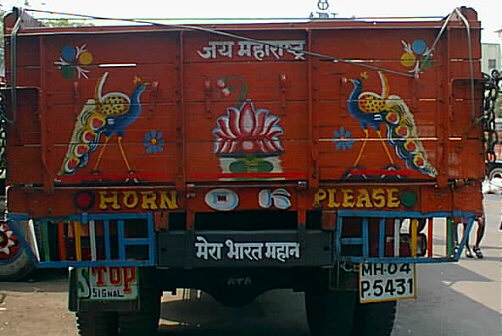 It's also the condition of the roads, one-lane asphalt roads slapped onto the dirt. No painted lane markers, no reflectors or street lights alongside the road, no traffic or road signs saying "yield" or "merge" or "hairpin curve ahead." Potholed, washboard, bumpy lanes of insanity crowded with motorcycles, cows, goats, rickshaws, the occasional car, and those mighty mites: Tata trucks -- heavy goods carriers colorfully decorated with paintings and tinsel and gold garland, puja flowers and lighted dashboard figurines of Hindu gods and goddesses, and signs on the rear bumper saying "Horn Please." Not many refuse this request, as the symphony of toots, blares and honks attest to.
I've watched road construction intently and with fascination. Women play a much larger part in construction in India than they do in the U.S. While the men pick and dig by hand, the women, with gaunt mahogany faces and wiry bodies dressed in colorful and dirty saris, load up dishes full of dirt or rocks and place them on their heads, carry them a short distance, then dump the contents in some kind of meaningful fashion. No need for a "bring your daughter to work" day here; babies and toddlers sit alongside the dirt piles while their mothers work, some free to roam about the construction area, some tethered by means of a long strip of cloth and a large rock. Old metal barrels (the tops and bottoms removed) with a wood fire built inside, are used to create a contraption that keeps the asphalt hot while they lay down the road chunk by chunk. Chemical fumes, dirt and dust, diesel vehicle exhaust and waves of heat swirl about in an intolerable quagmire.
And it's not just the roads, the drivers, and the mechanics, though after a few hours you become deaf and you can't move your body because it's been jerked, jiggled, and vibrated for so long, and you climb off to find your luggage covered with dirt. It's also the other passengers, who can squeeze in 5 or 6 passengers to our 2, and the beggars who can spot a foreigner within a half mile and zero in on you as the bus pulls in for a snack/bathroom break, relentlessly crying out "Hello Madam … excuse me … Hello! Madam … Madam …" in a match of wills as to who will give in first. And the street urchins descending on the bus, climbing up to the window where you sit, asking for chocolates or rupees or your country coin, and adolescent boys who gather in groups in small villages to throw rocks at the bus, one time breaking the back window and spraying glass on those of us lucky enough to sit in the rear seats.
Riding buses in India is outrageous and probably one of the most dangerous things I've done. A recent magazine article said that last year India had more traffic fatalities than the U.S. even though they have far fewer vehicles on the road, and their highways failed to pass international standards tests. And still we found ourselves boarding one after another, forever hopeful that "this one will be different." There's not much choice, really, if there isn't a train or you can't get a ticket for one, other than paying exorbitant amounts of money for private vehicles, which few Indians have, and which would simply place you on the same highway with the same bus -- and guess who's bigger?
We tried to avoid buses described in our guidebook as "bone crushing." And we swore only once -- well, that one didn't count -- we swore only twice to never take another "sleeper bus." We should have known that our first experience on one would become a legend when we arrived to find all the bus employees colored purple (see the following section about the "Holi" holiday). Randy was greatly inspired by this experience and wrote it all down soon after we lived to tell about it. I couldn't say it any better.
My First Indian Adventure
by Randy
|
| We settled into a hotel in Mumbai and took a couple of days to develop our India legs. We were approached by a man that had a small travel agent office right off the reception desk of the hotel and he told us that if we wanted tickets to go anywhere he would be happy to help. We went in to investigate the options to get to the state of Goa on the southern coast and he proudly showed us a picture of a shiny new bus that he said was a deluxe air-conditioned sleeper bus that traveled overnight to Goa. Let me interject at this point, that anyone who has traveled to 5 countries in 3 months and doesn't have every radar alarm in his body go off when someone pulls a picture of a bus off his desk deserves everything he is about to get. Well, the man confided that this was referred to as "the honeymoon bus". Again, the British army was marching in front of me in full regalia complete with elephants and I somehow missed the occupation. We plopped down our 2100 rupees and headed off to the place to catch the bus. What we came upon was something not at all like in the picture. And at the side situated around the engine were 10 guys furiously trying to make either the fuel pump or the hydraulic brake system stop leaking. After achieving this to their satisfaction, they announced it was time to get under way.Oh well, at least we could lie down and relax. The driver used a method of propulsion which consisted of standing straight up on either the gas pedal or the brake pedal and alternating from one to the other at seemingly random moments. Off we go into the night laying flat and literally being bounced halfway to the berth ceiling. Did I mention that 10 minutes into the trip it was announced that "there is a small problem with the air-conditioning"? |
 |
Here we are sailing down the road at warp 7 in the middle of the night. The driver is weaving and curving to miss among other things, other bus drivers, people walking, small scooters, and the occasional holy cow. I have my head hanging out the window and I look back in now and then to see Candi or Margie levitating like the bhagwan as a result of the latest chuckhole. Add to this the additional feature of the driver stopping every 2 hours in the middle of the road to tighten the lug nuts on the right front tire. I know this because from my vantagepoint of hanging out the window to get air, I could clearly see the bus crew. The topper came at 3 a.m. when suddenly the bus stopped (again right in the middle of the road) and the driver decided the whole problem was the tires hadn't been rotated recently. As everyone sat in their "honeymoon cells", the crew spent the next hour and a half rotating the tires on the bus. This statement deserves a "I am not kidding, they actually did this." Since they strategically stopped just around a curve, we were given the added attraction of watching vehicles coming out of the curve in a panic maneuver to avoid colliding with the bus. 18 hours after leaving Mumbai, only 5 hours behind schedule, we stepped off the bus at our destination city. One last thing. As the bus quickly pulled away we hailed a cab and asked how much it would cost to go the little way across town to the hotel we had selected. When the driver told us the amount, I replied indignantly "no way" and pointed to my Lonely Planet map to show him I knew we were not that far from the hotel. When will I ever learn. The driver looked at the map and replied "we are not in this town". "It is 30 kilometers from here".
|
After all we'd been through on our bus rides throughout India and Nepal, one would think we'd steer clear of the critters. And we did -- we trimmed the list of places we wanted to visit to a manageable number and lingered a little longer once we arrived. But, in the end, we must have slipped into some kind of psychotic episode because we talked about going to Dharamsala, a mountain town in northern India accessible only by way of a 10-hour bus ride. The only thing that stopped us was the threat of war between India and Pakistan.

